SRNM News & Community

QUINCY – [May 2026] – The International Association of Defense Counsel (IADC) has announced that Jim Hansen , a partner at Schmiedeskamp Robertson Neu & Mitchell LLP, has accepted an invitation to join the IADC, the preeminent invitation-only global legal organization for attorneys who represent corporate and insurance interests. Jim Hansen focuses his practice primarily on litigation, primarily trial work involving the defense of hospitals, physicians and nurses in lawsuits involving allegations of medical negligence through the states of Illinois and Missouri. Jim is a Fellow of the American College of Trial Lawyers. He most recently served as the chairperson of the Illinois Supreme Court Rules Committee from 2021-2025 and was appointed to the committee in 2015. Jim received his J.D. from Saint Louis University School of Law and his B.A. and M.B.A. from Western Illinois University. About the International Association of Defense Counsel The IADC is the preeminent invitation-only global legal organization for attorneys who represent corporate and insurance interests. Founded in 1920, the IADC’s members hail from six continents, 51 countries and territories, and all 50 U.S. states. The core purposes of the IADC are to enhance the development of skills, promote professionalism, and facilitate camaraderie among its members, their clients, as well as the broader civil justice community. For more information, visit www.iadclaw.org . About Schmiedeskamp Robertson Neu & Mitchell LLP The Schmiedeskamp firm was founded in 1914. Its lawyers, now 14 in number, represent clients in civil litigation, corporate governance, mergers and acquisitions, agribusiness, banking, education law, real estate, healthcare, estate planning, trust administration, probate, taxation, labor and employment law, and other areas of practice. The firm serves clients in Illinois, Missouri, Iowa, Arizona, Colorado, Florida, Texas, Wisconsin, Montana and the District of Columbia. More information about the firm and its lawyers is available at SRNM.com .
Update: Jim Hansen successfully obtained a defense verdict for Quincy Medical Group and one of its family practice physicians in a medical negligence case tried in October 2023. On January 23, 2026 the Illinois Supreme Court filed an opinion upholding the trial court verdict. Congratulations to Jim Hansen! ( See link to a copy of the Supreme Court of the State of Illinois Opinion ) On Tuesday, November 18, 2025, SRNM partner Jim Hansen argued in front of the Illinois Supreme Court on a case that he tried in 2023. Specifically, Hansen defended a family care physician and a medical group in defense of a medical negligence case that resulted in a Plaintiff sustaining a below knee amputation. Plaintiff had alleged that the physician failed to timely diagnose a Lis Franc injury which resulted in delayed treatment, complications and after multiple attempts to salvage his leg a below knee amputation. After six days of testimony the jury deliberated for a day and a half. On the eighth day of trial the jury returned a verdict of not guilty in favor of the Defendants. Plaintiff appealed claiming the trial court erred in denying the Plaintiff's motion for a mistrial after a juror sent a note back indicating to end deliberations, s/he would sign the verdict form for the Defendants. After receiving the note, the Court called the jury into the courtroom and issued the Prim instruction. The jury went back to deliberate further. After receiving an additional question, the jury returned a verdict 50 minutes later. The jury was polled. Plaintiff claimed the trial court erred in the polling process. On appeal, the Court of Appeals unanimously affirmed the trial court's decision and the verdict (2024 Ill.App. 4th) 240520-U . The Plaintiff petitioned for leave to appeal to the Illinois Supreme Court who accepted the case. ( See link to article from Law 360 ).
On Tuesday, November 18, 2025, SRNM partner Jim Hansen argued in front of the Illinois Supreme Court on a case that he tried in 2023. Specifically, Hansen defended a family care physician and a medical group in defense of a medical negligence case that resulted in a Plaintiff sustaining a below knee amputation. Plaintiff had alleged that the physician failed to timely diagnose a Lis Franc injury which resulted in delayed treatment, complications and after multiple attempts to salvage his leg a below knee amputation. After six days of testimony the jury deliberated for a day and a half. On the eighth day of trial the jury returned a verdict of not guilty in favor of the Defendants. Plaintiff appealed claiming the trial court erred in denying the Plaintiff's motion for a mistrial after a juror sent a note back indicating to end deliberations, s/he would sign the verdict form for the Defendants. After receiving the note, the Court called the jury into the courtroom and issued the Prim instruction. The jury went back to deliberate further. After receiving an additional question, the jury returned a verdict 50 minutes later. The jury was polled. Plaintiff claimed the trial court erred in the polling process. On appeal, the Court of Appeals unanimously affirmed the trial court's decision and the verdict (2024 Ill.App. 4th) 240520-U . The Plaintiff petitioned for leave to appeal to the Illinois Supreme Court who accepted the case. ( See link to article from Law 360 ).
SRNM Newsletter
SRNM News Alerts & Legal Updates

By Joseph B. Ott of Schmiedeskamp Robertson Neu & Mitchell LLP, Illinois Estate Planning Attorney
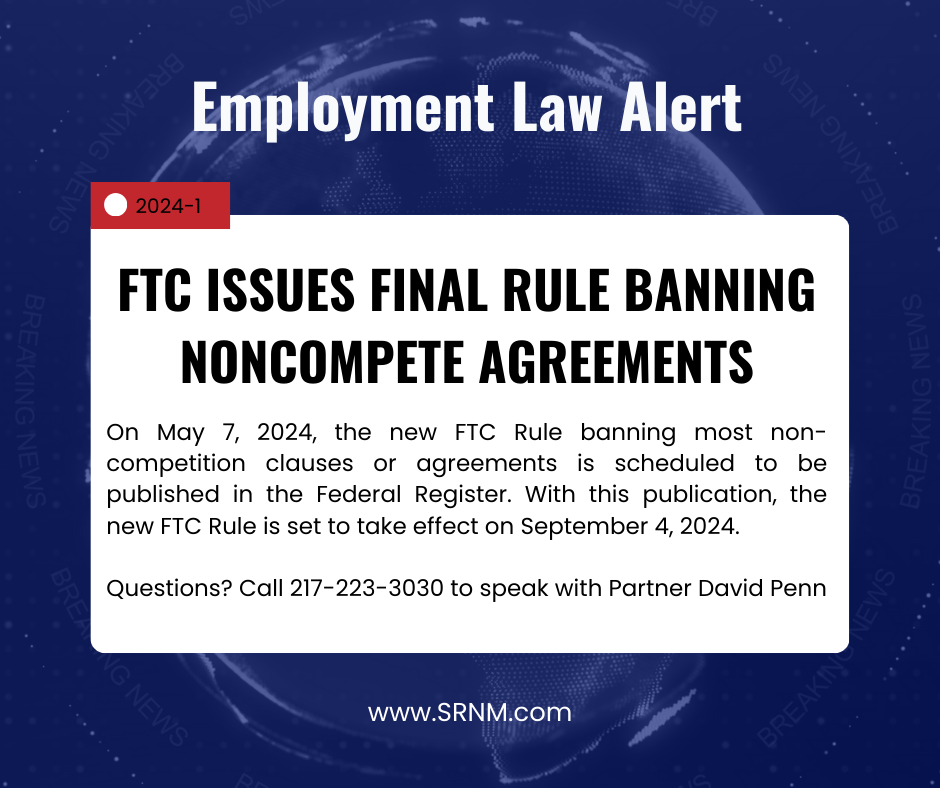
Click Here for PDF Version On May 7, 2024, the new FTC Rule banning most non-competition clauses or agreements is scheduled to be published in the Federal Register. With this publication, the new FTC Rule is set to take effect on September 4, 2024. The FTC summarized the Rule with the following key points: • The Rule introduces a comprehensive ban on new noncompetes with all workers, including senior executives; • Noncompetes found to be an unfair method of competition; • Existing noncompetes with workers other than senior executives are not enforceable after the effective date (currently September 4, 2024); • Different approach for some - existing noncompetes for senior executives can remain in force IF "senior executive" earns more than $151,164 and in "policy-making position." Noncompete Rule The Final Rule is very broad and, pending litigation challenging the Rule, will impact most noncompete clauses and agreements between entities subject to FTC jurisdiction and employees, independent contractors, externs, interns, vohu1teers, apprentices, and certain sole proprietors. Note that the Final Rule does not apply to most not-for-profit entities, and certain financial institutions, because those entities are outside the FTC's jurisdiction. Further, it does not apply to a "worker" for a franchisee in the context of a franchisee-franchisor relationship. However, the Final Rule permits employers to enforce noncompete covenants that are entered pursuant to the bona fide sale of a business entity, of the person's ownership in a business entity, or of all or substantially all of the entity's operating assets. The Final Rule defines a "non-compete clause" broadly to include a term or condition of employment that either "prohibits a worker from, penalizes a worker for, or functions to prevent a worker from" seeking or accepting work with a competitor, or operating a competing business. The Final Rule, therefore, captures agreements that "penalize" a worker who takes (or seeks to take) a job with a competitor. Further included in the definition are covenants in a severance agreement between an employer and employee that conditions payment on non-competition. Finally, the Final Rule imposes a substantial procedural burden on employers to provide written notice to all workers who do not fall within the "senior executive" or sale-of-business exceptions that existing covenants not to compete will be invalid as of the effective date of the Final Rule. Specifically, the Final Rule requires employers, by the effective date, to provide "clear and conspicuous notice" in writing to such workers that their non-compete clauses will not be, and cannot legally be, enforced against them. The FTC included an approved form of notice with the Final Rule. WHAT DOES THIS MEAN FOR YOU? 1. Lawsuits have already been filed challenging the legality and enforceability of the Final Rule. As a result, there is still a possibility the effective date of the Final Rule could be delayed and pushed later into the future. 2. Notices - we do NOT recommend providing the required written notice to employees at least until August to see what impact pending litigation has on the enforcement of the Final Rule. 3. In the meantime, identify all individuals that you have noncompete agreements with to be ready. Employment Law Alert is a service to our clients, friends, and colleagues. This is not intended to be legal advice, but rather, to provide accurate information regarding employment law matters. For more information regarding employment law matters, please contact David G. Penn (dpenn@srnm.com). Our telephone number is (217) 223-3030. Please visit our website: www.srnm.com. We invite and welcome all questions and comments. © 2024 Schmiedeskamp Robertson Neu & Mitchell LLP
Community Service Is Important To Us
Schmiedeskamp lawyers and staff are well-known throughout the region as leaders who care about the people and the communities they serve.
The firm, along with numerous lawyers and staff, financially support and volunteer their time to help many agencies, both civic and charitable in ways that make a difference for their neighbors, clients and communities.
For more than 100 years, passion for their clients and their partners have made the Schmiedeskamp firm a model for longevity and success.